
Skip to content
Program in Islamic Law

Program in Islamic Law

Promoting research and providing resources to advance the academic study of Islamic law

SCROLL DOWN
Scroll down to content
  • About
    • About Us
      • Who We Are
      • What We Do
      • What We Cover
    • Events
      • Harvard Events
      • Event Videos
      • Islamic Law Calendar
    • News
      • News & Announcements
      • Monthly Newsletters
      • Podcasts
  • People
    • Faculty & Staff
    • Fellows & Students
    • Advisors & Affiliates
  • Projects
    • SHARIAsource Portal
    • SEARCHstrata
    • CnC: Data Science Tools
  • Publications
    • Book Series
    • Journal & Online Forum
    • Islamic Law Blog
  • Resources
    • For Students
      • Courses and Degrees
      • Research Opportunities
      • Paper Prize
    • For Scholars
      • Fellowships
      • Editorships
      • Affiliation
    • For All
      • Jobs, Grants, CFPs
      • Related Links & Orgs
      • Policies & Guides

NewsletterDecember NewsletterThe Program in Islamic Law’s (PIL) monthly newsletter is out for the month of December! This newsletter features the call for applications for the PIL Research Fellowship, essay by last the ISLAMICLAWblog's recent Guest Blog Editor, and much more! Subscribe to receive the newsletter every month! View previous newsletters which are packed with updates and research in the field of Islamic Law and Data Science.
CalendarThe Program in Islamic Law at Harvard Law School (PIL) is pleased to announce an exciting lineup of virtual events this Fall 2025. We host myriad public events and provide other programming and support for students, research fellows, and scholars working in the field of Islamic legal studies, with attention to the intersection of those studies with data science. About the Program. PIL is a research program dedicated to promoting research and providing resources for the academic study of Islamic law and history, using data science, through a host of online and offline programs, including the following: SHARIAsource Portal: for primary sources, special collections, and data science tools Islamic Law Blog: cutting-edge commentary by leading scholars and curated roundups Journal of Islamic Law: featuring peer-reviewed scholarly articles, and a Forum for debate Harvard Series in Islamic Law: our book series with Harvard University Press Professor Intisar Rabb leads the Program as Faculty Director and editor-in-chief of the Publications. Subscribe to our blog for regular developments and subscribe to our mailing lists for updates on events and publications by visiting our website. PIL FALL 2025 EVENTS PIL convenes an Islamic Law Speaker Series that provides a forum for established and emerging scholars to talk about their own recent scholarship, works-in-progress, or developments in the field. Unless otherwise noted, all sessions will be convened and moderated by Dr. Rami Koujah, the 2025-2026 PIL Research Fellow at the Program in Islamic Law. The SHARIAsource Lab, convened by Professor Intisar Rabb, brings together students and researchers to focus on emerging tools in the Islamic digital humanities / data science space, and to developing new components of our in-house data science tools. TUE 14 OCT 2025 | 12.30-1.30p US EST | Zoom Islamic Law Speaker Series :: Rami Koujah (Harvard Law School) The Invention of Islamic Legal Personhood: Artifact to Ontology On Tuesday, October 14, 2025, at 12:30-1:30PM US EST via Zoom, Dr. Rami Koujah (Harvard Law School) will present "The Invention of Islamic Legal Personhood: From Artifact to Ontology," a chapter from his forthcoming book, Islamic Legal Personhood: A Genealogy of Rights and Responsibilities (Harvard University Press). This talk explores the conceptual history and significance of "baseline personhood" in Islamic law, focusing on the changed meaning and usage of the term dhimma across the tribal setting of pre-Islamic Arabia, the legal discourses that developed to accommodate the burgeoning market economy of the early Muslim Empire, and the subsequent theorizations of an Islamic jurisprudence infused with a covenantal theology. The talk draws attention to the creative dynamics of Islamic legal reasoning, including the critical role played by shifting epistemic frames between legal logic and the legal imagination. The talk concludes by showing how dhimma emerged in the 11th century as a constitutive element of a metaphysical anthropology, the ontological ground of an Islamic homo juridicus. Professor Mohammad Fadel (University of Toronto) will respond. Registration is required. TUE 11 NOV 2025 | 12.30-1.30p US EST | Zoom Islamic Law Speaker Series :: Youssef Belal (United Nations) "Thinking the World with Islamic Knowledges" On Tuesday, November 11, 2025, at 12:30-1:30PM US EST via Zoom, Youssef Belal (United Nations) will present "Thinking the World with Islamic Knowledges” from his book The Life of Shari'a: A Comparative Anthropology of Law (University of California Press, 2025). Is there a way to think about contemporary life with knowledge that is neither modern nor Western? Rather than confining Islam to a “religion” and sharīʿa to its “law,” Belal argues that Islamic shariʿa is a mode of knowledge with its own concepts and scholarly categories through which the world and the self are grasped. The Life of Sharīʿa considers two intertwined lineages: how Islamic scholars have formulated sharīʿa knowledge from the classical period to today and how Westerners have understood the law and its origins. By melding these two traditions, Belal formulates a new genealogy of modern law from the perspective of sharīʿa. Through a new conceptualization of sharīʿa, he offers an argument for its continued relevance to the life of contemporary Muslims. Registration is required.  

OpportunityThe Program in Islamic Law at Harvard Law School is pleased to invite applications for the 2026-2027 PIL Research Fellowship (due: February 13, 2026). This fellowship is designed to provide an intellectual home to promising young scholars in Islamic legal studies, to advance their research, and to contribute to the intellectual life of the Program and the greater Harvard community. The opportunity allows the selected fellow to pursue independent research on Islamic law and history that utilizes the extensive collections of the Harvard Libraries. The PIL Research Fellowship award is a full-time residential fellowship at Harvard Law School (for nine months, during the academic year). Successful applicants will have completed an advanced degree (JD, PhD, or SJD) before the start of the fellowship, and plan to pursue a scholarly research agenda in Islamic law that engages legal history, law and society, or comparative law approaches. Fellows will receive a stipend for the duration of the fellowship. To apply for this fellowship, please submit the following materials via the research fellowship online application form by February 13, 2026: a curriculum vitae a research proposal consisting of a single-paragraph abstract of your proposed research a research statement, not to exceed 1500 words (3 single-spaced pages), and a bibliography of works you have consulted that describes the proposed work during the fellowship period. The proposal should outline research in your area of expertise or interest related to contemporary or historical issues of Islamic law that can be accomplished during the fellowship term; projects are to utilize the Harvard collections to advance a novel contribution to scholarship through research in Islamic law, with a legal history, comparative law, or law and society approach. an explanation of why Harvard/PIL is the required venue for your research (e.g., identification of specific Harvard/PIL resources that are necessary to pursue the research project) a writing sample of no more than 25 pages in length, in English (which can be a recent publication or unpublished work; works-in-progress are especially welcome) 3 reference letters from recommenders who are to upload letters directly at the referee link. A panel of scholars at Harvard will review your application materials. The panel will consider your application in relation to numerous other proposals. Evaluation criteria will include:  The significance of the contribution that the project will make to knowledge in the field The quality or the promise of quality of the work The quality of the conception, definition, organization and description of the project The likelihood that the applicant will complete the project The appropriateness of the research for Harvard/PIL resources Please ensure that your references have ample time to consider and comment on your proposal. Letters of reference are more highly regarded if they address the specific proposed activity and how well the candidate is suited to undertake it, as opposed to letters that verify character, limit comments to previous work, or make only general observations on the topic. Following a process of committee review, applicants will be notified of decisions in March.  Deadline: February 13, 2026

VideoOn Tuesday, October 14, 2025, at 12:30-1:30PM US EST via Zoom, Dr. Rami Koujah (Harvard Law School) presented “The Invention of Islamic Legal Personhood: From Artifact to Ontology,” a chapter from his forthcoming book, Islamic Legal Personhood: A Genealogy of Rights and Responsibilities (Harvard University Press, forthcoming). This talk explored the conceptual history and significance of “baseline personhood” in Islamic law, focusing on the changed meaning and usage of the term dhimma across the tribal setting of pre-Islamic Arabia, the legal discourses that developed to accommodate the burgeoning market economy of the early Muslim Empire, and the subsequent theorizations of an Islamic jurisprudence infused with a covenantal theology. The talk drew attention to the creative dynamics of Islamic legal reasoning, including the critical role played by of shifting epistemic frames between legal logic and the legal imagination. It concluded by showing how the concept of dhimma emerged in the 11th century as a constitutive element of a metaphysical anthropology, —the ontological ground of an Islamic homo juridicus. Professor Mohammad Fadel (University of Toronto) responded. Watch the video today!

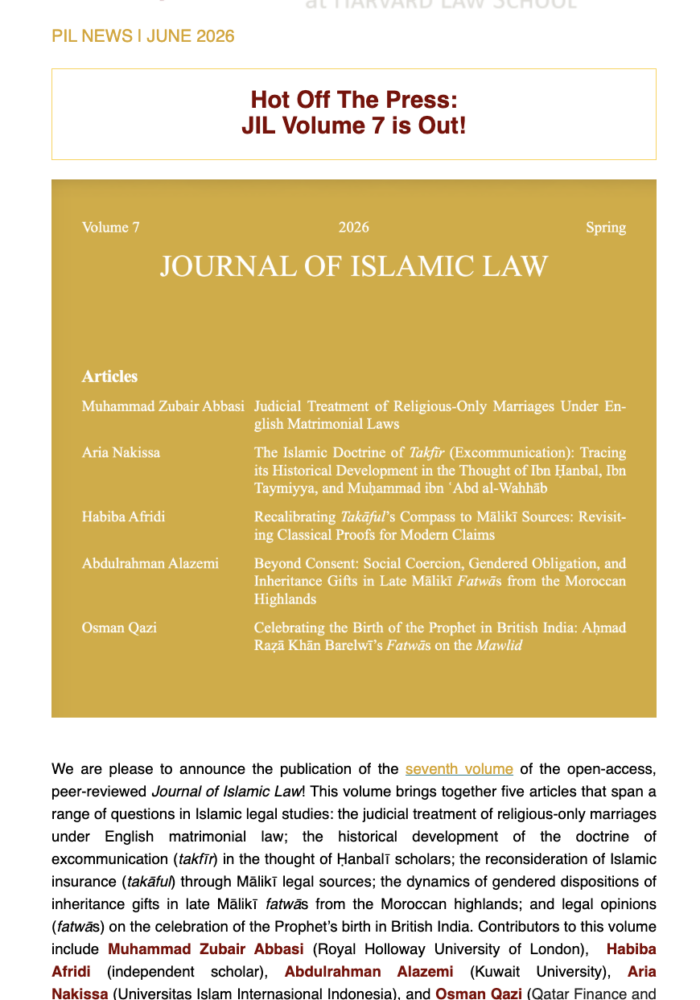
AnnouncementWe are please to announce the publication of the sixth volume of the open-access, peer-reviewed Journal of Islamic Law, with a special issue titled “Between Divine Mandate and the Modern State: The Contested Legacy of Ḥudūd in Islamic Criminal Law.” A total of eight contributions to the volume examine ḥudūd laws across a range of contemporary Muslim-majority contexts including Indonesia, Iran, Morocco, Pakistan, and Saudi Arabia. This volume features articles by Muhammad Zubair Abbasi (Royal Holloway, University of London), Hazim H. Alnemari (Islamic University of Madinah), Anggi Azzuhri (Universitas Islam Internasional Indonesia), Mohsen Borhani (University of Tehran), Tabinda Mahfooz Khan (El Colegio de México), Mohamed Mitiche (University of Johannesburg), and Mohammadamin Radmand (independent researcher) as well as essays by Hamidreza Asimi (University of Tehran) together with Jamshid Gholamloo (University of Turin), and Yannis Mahil (GISTU University). Explore the issue today!

NewsletterNovember NewsletterThe Program in Islamic Law’s (PIL) monthly newsletter is out for the month of November! This newsletter features the work currently underway in the SHARIAsource Lab, essay by last the ISLAMICLAWblog's recent Guest Blog Editor, and much more! Subscribe to receive the newsletter every month! View previous newsletters which are packed with updates and research in the field of Islamic Law and Data Science.
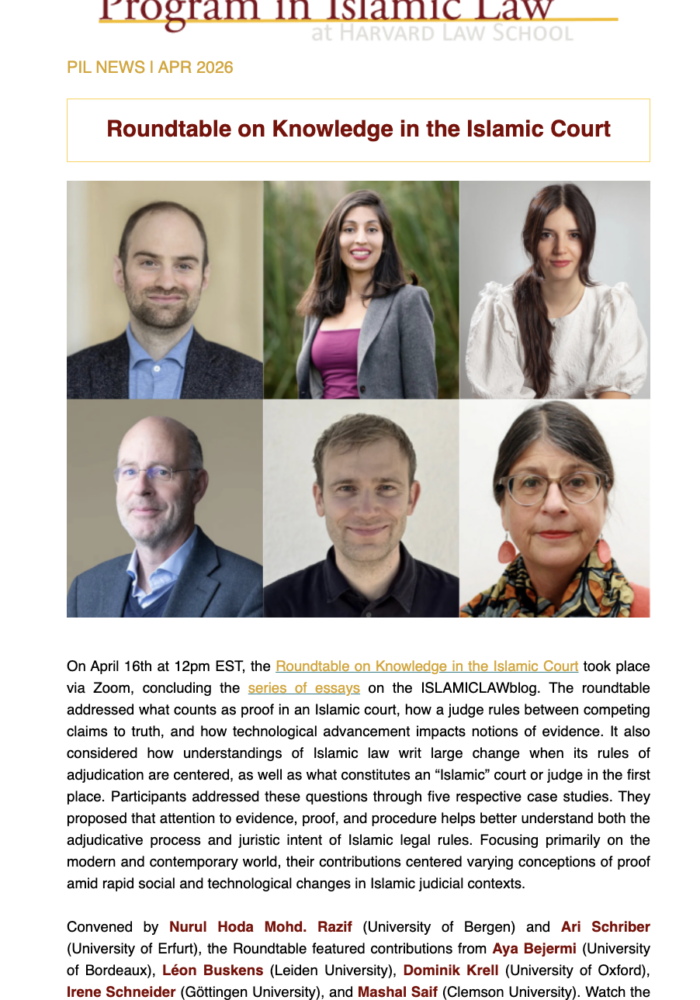
NewsletterOctober NewsletterThe Program in Islamic Law’s (PIL) monthly newsletter is out for the month of October! This newsletter feature the recent event from our Islamic Law Speaker Series, Indian Supreme Court cases,  last month's guest blog posts, and more! Subscribe to receive the newsletter every month! View previous newsletters which are packed with updates and research in the field of Islamic Law and Data Science.
VideoOn Tuesday, April 8, 2025, at 12:30-1:30PM US EST via Zoom, Professor Sarah Savant (Aga Khan University) presented “A Cultural History of the Arabic Book: Digital Explorations of Writerly Practices and Text Reuse.” The talk explored how one could reconstruct how major authors in the Arabic language from the eighth to sixteenth centuries wrote their books– the sources they used, what they copied out, and the scholars they knew. For most of these authors, reusing earlier works was the starting point for creating new ones. They abbreviated long works to make short ones, commented on short ones to make long ones, and mined general histories to compose works on specific themes. In these and many other ways, authors produced an enormously intertextual tradition, shaping how later individuals and communities would remember their pasts and conceive of their affiliations to groups bound by locality, profession, religion, tribe, ethnicity and other shared traits. To make the reconstruction of these relations possible on a large scale, the KITAB (Knowledge, Information Technology, & the Arabic Book) project built a digital corpus of thousands of these early Arabic books comprising more than two billion words. The talk addresses topics ranging from religion, philosophy and language to history, geography, medicine and astronomy, that were written over the first ten centuries of Islam in a region spanning from modern Spain to Central and South Asia. The team then utilized a text reuse detection algorithm to create an original data set that documents word-for-word relationships among all these books. This talk visualizes and investigates the broad patterns of text reuse using the KITAB data set and forensically analyze individual works to observe the tradition both from a satellite perspective and through a microscope, as it were. Watch the video today!

VideoOn Tuesday, March 11, 2025, at 12:30-1:30PM US EST via Zoom, Professor Mohsen Kadivar (Duke University) presented “The Genealogy of the Death Penalty for Apostasy and Blasphemy in Islam.” This talk examines the historic invention and spread reports attributed to the Prophet (ḥadīth) in support of a criminal penalty—and in some cases capital punishment—for apostasy in Islamic law. These reports have served as the foundation for conservative textualist interpretations of Islamic criminal law. Kadivar argues, however, that the texts in question are weak, have no known chain of transmitters, and were often isolated rather than from numerous narrators who would have first “heard” and transmitted the report. Furthermore, he argues, these texts directly contradict the Qurʾān, Islam’s main foundational text, which condemns but never mentions any criminal punishment for blasphemy, apostasy, or otherwise leaving Islam.  Tracing the historical process of text-fabrication, Kadivar suggests that these texts entered the Islamic ḥadīth collections with reference to other Near Eastern traditions of the time during Islam’s first two dynasties—under Umayyad and Abbasid rulers, between 661 and 1258. One text in particular imposing the death penalty for those who change their religion (to be discussed in the talk), emerged only in the eighth and ninth centuries—more than a century after the death of the Prophet Muḥammad, first in mainstream Sunnī communities. A century later, such texts spread and were attributed to the Shīʿī Imams, who enjoy authority over their respective minority communities. This talk explores the process of the creation and dissemination of a serious criminal penalty that seems to be based on authentic Islamic texts, but that close review reveals was not.

VideoOn Tuesday, February 11, 2025, at 12:30-1:30PM US EST, Professor Malika Zeghal (Harvard University) presented The Making of the Modern Muslim State: Islam and Governance in the Middle East and North Africa (Princeton University Press, 2024). This book reframes the role of Islam in modern Middle East governance. Challenging other accounts that claim that Middle Eastern states turned secular in modern times, Professor Zeghal shows instead the continuity of the state’s custodianship of Islam as the preferred religion. Drawing on intellectual, political, and economic history, she traces this custodianship from early forms of constitutional governance in the nineteenth century through post–Arab Spring experiments in democracy. She argues that the intense debates around the implementation and meaning of state support for Islam led to a political cleavage between conservatives and their opponents that long predated the polarization of the twentieth century that accompanied the emergence of mass politics and Islamist movements. Examining constitutional projects, public spending, school enrollments, and curricula, Professor Zeghal shows that although modern Muslim-majority polities have imported Western techniques of governance, the state has continued to protect and support the religion, community, and institutions of Islam. She finds that even as Middle Eastern states have expanded their nonreligious undertakings, they have dramatically increased their per capita supply of public religious provisions, especially Islamic education—further feeding the political schism between Islamists and their adversaries. Watch the video today!

PIL NewsAs we kick off the new year, we reflect on the highlights of the past year at the Program in Islamic Law and the SHARIAsource Lab! We’ve brought it all together with a video montage of the year in pictures and a summary of all the progress we made in 2024. First are the events. We began the year with a Roundtable on Transformation and Adaptation of Ottoman Land Law in 19th-Century Successor States organized by Fatma Gül Karagöz, which featured a series of papers on the interpretation and adaptation of Ottoman land law in the 19th century, and concluded with a live roundtable. We also kicked off 2024 with the Islamic Law Speakers Series! Last spring, Mohammed Allehbi, gave a talk on “Creating a new Criminal Law: The Military-Administrative origins of Siyasa,” Youcef Soufi joined us for a book talk on his recent publication, The Rise of Critical Islam: 10th-13th Century Legal Debate (Oxford University Press, 2023),  Fatma Gül Karagöz presented “The Transition of Ottoman Land Law: Theory and Practice between 16th-18th Centuries,” and Phillip Wood spoke about his book, The Imam of the Christians: The World of Dionysius of Tel-Mahre, c. 750–850 (Princeton University Press, 2021). The lecture series continued this fall with a book talk by Recep Şentürk on Ādamiyyah: An Islamic Approach to Universal Human Rights (Usul Academy Press, 2025), a presentation by Ali Rod Khadem titled “Islamic Apocalyptic Jurisprudence: End-Times Law in Sunnī and Shīʿī Discourses” (Islamic Law and Society 31 (3), 2024), and a book talk by our PIL-LC Research Fellow, Bahman Khodadadi titled On Theocratic Criminal Law: The Rule of Religion and Punishment in Iran (Oxford University Press, 2024). We hope that these events’ videos—posted on the PIL website and Vimeo channel—will whet your appetite for the series to come this spring. Then there are the publications. We published the fifth volume of the Journal of Islamic Law: a special issue on “Governing Islam: Law and the State in the Modern Age.” The Islamic Law Blog—which reached almost 100,000 readers in 2024—published nearly 200 new works of scholarship such as short essays and scholarly commentary by experts in the field, resource roundups, and weekly roundups on new scholarship and key news or cases related to Islamic law, including last year’s Roundtable on the Transformation and Adaptation of Ottoman Land Law in 19th-Century Successor States. Some of the Blog’s top essays in 2024 include “Fatwās on Cryptocurrency,” “Experiments in Mapping Islamic Legal Canons,” and “Islamic Legal Canons as Memes.” Next are the experiments we’re doing with data science and AI + Islamic law in the SHARIAsource Lab. Led by Professor Intisar Rabb and data scientist Noah Tashbook, Lab members from the law school and graduate schools worked together to build a data set for analyzing Islamic law with digital humanities tools—working on a platform for parsing and displaying legal canons in ways accessible to researchers interested in new ways to access older texts. Our core suite of applications and tools  SHARIAsource-Analytics,  SHARIAsource-Metadata, and SEARCHstrata result from collaborations between scholars, data scientists, and students. We believe that, in the age of AI, these collaborative efforts will revolutionize the field by facilitating new research and insights into Islamic law and history. Curious about the Lab’s most recent activities? Read the recent report on our experiments in mapping Islamic legal canons to get a sense of the work underway and the tools in development. On the fun side of things, we continued #MemeMondays on our @SHARIAsource Instagram account, which rounds up a collection of Islam, Islamic studies, and data science related memes submitted by you and whose reach grew by over 300% in 2024! Last but not least, we welcomed an exciting slate of new People. We welcome back a new executive director, Rashid Alvi, who is here for a second stint as staff director to help take the Program in Islamic Law and the SHARIAsource lab to new horizons. We also welcomed Research Data Scientist, Noah Tashbook, Digital Humanities Specialist, Irene Kirchner, and new Managing Editor, Cem Tecimer. We bid adieu to last year’s research fellows, Mohammed Allehbi and Fatma Gül Karagöz, and welcomed this year’s PIL-LC Research Fellow (in collaboration with the Library of Congress), Bahman Khodadadi. All of this has been achieved with the continuing support and engagement of both the local and broader global community members, such as yourself. Thank you— our work is made possible by you. Join us as we revisit the moments that defined last year and look ahead to an even brighter 2025!

NewsletterSeptember NewsletterThe Program in Islamic Law’s (PIL) monthly newsletter is out for the month of September! This newsletter feature's our event line-up for the fall, our country profiles special collection,  last month's guest blog posts, and more! Subscribe to receive the newsletter every month! View previous newsletters which are packed with updates and research in the field of Islamic Law and Data Science.

PreviousNext

Upcoming Events

Loading view.
  • January 2026

Calendar of Events

M Mon

T Tue

W Wed

T Thu

F Fri

S Sat

S Sun

2 events, 29

2025-12-29

Call for Submissions: Journal of Trends in Intellectual Property Research, Volume 3, Issue 2, December 29, 2025

Call for Submissions: Journal of Trends in Intellectual Property Research, Volume 3, Issue 2, December 29, 2025

December 29, 2025

Call for Submissions: Journal of Trends in Intellectual Property Research, Volume 3, Issue 2, December 29, 2025

About the Journal: Trends in Intellectual Property Research (DOI: 69971; ISSN: 3007-8539 (Online), 3007-8520 (Print) publishes research papers, review papers, case comments and books reviews related to all aspects of …

Continue Reading
2025-12-29

Call for Submissions: Journal of Legal Research & Analysis, Volume 3, Issue 2, December 29, 2025

Call for Submissions: Journal of Legal Research & Analysis, Volume 3, Issue 2, December 29, 2025

December 29, 2025

Call for Submissions: Journal of Legal Research & Analysis, Volume 3, Issue 2, December 29, 2025

  About the Journal: Legal Research & Analysis (DOI Prefix: 10.69971; ISSN: 3007-6455 (Online), 3007-6447 (Print) publishes research papers, review papers, case comments and books reviews related to all aspects …

Continue Reading

0 events, 30

0 events, 31

0 events, 1

0 events, 2

0 events, 3

0 events, 4

0 events, 5

2 events, 6

2026-01-06

2026 Association of American Law Schools (AALS) Annual Meeting, New Orleans, January 6-9, 2026

2026 Association of American Law Schools (AALS) Annual Meeting, New Orleans, January 6-9, 2026

January 6 - January 9

2026 Association of American Law Schools (AALS) Annual Meeting, New Orleans, January 6-9, 2026

The Association of American Law Schools (AALS) will host its Annual Meeting from January 6 to 9, 2026, in New Orleans. Theme: “Impact, Excellence, Resilience: The Enduring Contributions of Legal …

Continue Reading
2026-01-06

Conference: Association of American Law Schools (AALS) Annual Meeting, New Orleans, LA, January 6–9, 2026

Conference: Association of American Law Schools (AALS) Annual Meeting, New Orleans, LA, January 6–9, 2026

January 6 - January 9

Conference: Association of American Law Schools (AALS) Annual Meeting, New Orleans, LA, January 6–9, 2026

From the organizers: We’re excited to return to New Orleans! Join us for the 2026 AALS Annual Meeting, taking place in person from Tuesday, January 6 to Friday, January 9, …

Continue Reading

2 events, 7

2026-01-06

2026 Association of American Law Schools (AALS) Annual Meeting, New Orleans, January 6-9, 2026

2026-01-06

Conference: Association of American Law Schools (AALS) Annual Meeting, New Orleans, LA, January 6–9, 2026

2 events, 8

2026-01-06

2026 Association of American Law Schools (AALS) Annual Meeting, New Orleans, January 6-9, 2026

2026-01-06

Conference: Association of American Law Schools (AALS) Annual Meeting, New Orleans, LA, January 6–9, 2026

3 events, 9

2026-01-06

2026 Association of American Law Schools (AALS) Annual Meeting, New Orleans, January 6-9, 2026

2026-01-06

Conference: Association of American Law Schools (AALS) Annual Meeting, New Orleans, LA, January 6–9, 2026

2026-01-09

Call for applications: Lilly Scholar in Residence Short-term Fellowship for Technology & African and Middle Eastern Religious Cultures, Library of Congress, January 9, 2026

Call for applications: Lilly Scholar in Residence Short-term Fellowship for Technology & African and Middle Eastern Religious Cultures, Library of Congress, January 9, 2026

January 9

Call for applications: Lilly Scholar in Residence Short-term Fellowship for Technology & African and Middle Eastern Religious Cultures, Library of Congress, January 9, 2026

  Praying in a Machine World: Technology & African and Middle Eastern Religious Cultures – Lilly Scholar in Residence Short-term Fellowship Apply here The African and Middle Eastern Division (AMED) …

Continue Reading

0 events, 10

0 events, 11

0 events, 12

0 events, 13

0 events, 14

0 events, 15

0 events, 16

0 events, 17

0 events, 18

0 events, 19

1 event, 20

2026-01-20

Call for Proposals: 2026 Sponsored Event Program, American Society of Comparative Law, January 20, 2026

Call for Proposals: 2026 Sponsored Event Program, American Society of Comparative Law, January 20, 2026

January 20

Call for Proposals: 2026 Sponsored Event Program, American Society of Comparative Law, January 20, 2026

The American Society of Comparative Law (ASCL) is pleased to issue a Call for Proposals for its 2026 Sponsored Event Program. The Program will provide a $3,000 grant to a …

Continue Reading

1 event, 21

19:00 - 20:00

Book Talk: How Commerce Became Legal: Merchants and Market Governance in Nineteenth-Century Egypt by Omar Youssef Cheta (Syracuse University), January 21, 2026 @ 7:00pm

January 21 @ 19:00 - 20:00

Book Talk: How Commerce Became Legal: Merchants and Market Governance in Nineteenth-Century Egypt by Omar Youssef Cheta (Syracuse University), January 21, 2026 @ 7:00pm

From the American Society for Legal History: Please join us for the next Making Connections: New Works in Legal History series event on Wednesday, January 21, 6-7pm Central Time. Omar …

Continue Reading

0 events, 22

0 events, 23

0 events, 24

0 events, 25

1 event, 26

2026-01-26

Call for applications: Keyman Modern Turkish Studies Postdoctoral Fellowship, Northwestern University, January 26, 2026

Call for applications: Keyman Modern Turkish Studies Postdoctoral Fellowship, Northwestern University, January 26, 2026

January 26

Call for applications: Keyman Modern Turkish Studies Postdoctoral Fellowship, Northwestern University, January 26, 2026

The Keyman Program offers postdoctoral fellowships as well as visiting professor and visiting scholar programs. Call for Applications  Northwestern University, Buffett Institute for Global Affairs Keyman Modern Turkish Studies Postdoctoral …

Continue Reading

0 events, 27

0 events, 28

0 events, 29

1 event, 30

2026-01-30

Call for Submissions: Fusayfsa’, the Smith College student-led Middle East Studies Journal, January 30th, 2026

Call for Submissions: Fusayfsa’, the Smith College student-led Middle East Studies Journal, January 30th, 2026

January 30

Call for Submissions: Fusayfsa’, the Smith College student-led Middle East Studies Journal, January 30th, 2026

Fusayfsa`, Smith College’s student-led Middle East Studies Journal, is currently accepting submissions from undergraduate students to contribute to our fifth edition! We are looking for research papers, opinion pieces, book/movie …

Continue Reading

3 events, 31

2026-01-31

Call for Papers: Association for the Study of Law, Culture, and the Humanities Annual Conference, Chicago, January 31, 2026

Call for Papers: Association for the Study of Law, Culture, and the Humanities Annual Conference, Chicago, January 31, 2026

January 31 - February 1

Call for Papers: Association for the Study of Law, Culture, and the Humanities Annual Conference, Chicago, January 31, 2026

From the organizers: Every year, the Association holds it annual conference, usually a two-day affair, as well as a graduate student workshop, usually held the day before the annual conference. …

Continue Reading
2026-01-31

Call for papers: 40th Annual Middle East History and Theory Conference (MEHAT), University of Chicago, January 31, 2026

Call for papers: 40th Annual Middle East History and Theory Conference (MEHAT), University of Chicago, January 31, 2026

January 31

Call for papers: 40th Annual Middle East History and Theory Conference (MEHAT), University of Chicago, January 31, 2026

The 40th Annual Middle East History and Theory Conference (MEHAT) at The University of Chicago will take place on May 1-2, 2026.   About the Conference. Since its inception four decades ago, …

Continue Reading
2026-01-31

Call for Papers: Humanities of AI Workshop—Intelligence and Imitation: Mind, Mechanism, Mimesis, Johns Hopkins University, January 31, 2026

Call for Papers: Humanities of AI Workshop—Intelligence and Imitation: Mind, Mechanism, Mimesis, Johns Hopkins University, January 31, 2026

January 31

Call for Papers: Humanities of AI Workshop—Intelligence and Imitation: Mind, Mechanism, Mimesis, Johns Hopkins University, January 31, 2026

Intelligence and Imitation: Mind, Mechanism, Mimesis Inaugural Humanities of AI Workshop Johns Hopkins University, April 24-26, 2026 As a creative aspiration, the Greek notion of mimesis (“imitation”) manifested not only …

Continue Reading

1 event, 1

2026-01-31

Call for Papers: Association for the Study of Law, Culture, and the Humanities Annual Conference, Chicago, January 31, 2026

December 29
All day

Call for Submissions: Journal of Trends in Intellectual Property Research, Volume 3, Issue 2, December 29, 2025

All day

Call for Submissions: Journal of Legal Research & Analysis, Volume 3, Issue 2, December 29, 2025

  • There are no events on this day.
  • There are no events on this day.
  • There are no events on this day.
  • There are no events on this day.
  • There are no events on this day.
  • There are no events on this day.
  • There are no events on this day.
January 6
All day

2026 Association of American Law Schools (AALS) Annual Meeting, New Orleans, January 6-9, 2026

All day

Conference: Association of American Law Schools (AALS) Annual Meeting, New Orleans, LA, January 6–9, 2026

January 6
All day

2026 Association of American Law Schools (AALS) Annual Meeting, New Orleans, January 6-9, 2026

All day

Conference: Association of American Law Schools (AALS) Annual Meeting, New Orleans, LA, January 6–9, 2026

January 6
All day

2026 Association of American Law Schools (AALS) Annual Meeting, New Orleans, January 6-9, 2026

All day

Conference: Association of American Law Schools (AALS) Annual Meeting, New Orleans, LA, January 6–9, 2026

January 6
All day

2026 Association of American Law Schools (AALS) Annual Meeting, New Orleans, January 6-9, 2026

All day

Conference: Association of American Law Schools (AALS) Annual Meeting, New Orleans, LA, January 6–9, 2026

All day

Call for applications: Lilly Scholar in Residence Short-term Fellowship for Technology & African and Middle Eastern Religious Cultures, Library of Congress, January 9, 2026

  • There are no events on this day.
  • There are no events on this day.
  • There are no events on this day.
January 21
January 21 @ 19:00 - 20:00

Book Talk: How Commerce Became Legal: Merchants and Market Governance in Nineteenth-Century Egypt by Omar Youssef Cheta (Syracuse University), January 21, 2026 @ 7:00pm

  • There are no events on this day.
  • There are no events on this day.
  • There are no events on this day.
  • There are no events on this day.
  • There are no events on this day.
  • There are no events on this day.
January 20
All day

Call for Proposals: 2026 Sponsored Event Program, American Society of Comparative Law, January 20, 2026

January 21
January 21 @ 19:00 - 20:00

Book Talk: How Commerce Became Legal: Merchants and Market Governance in Nineteenth-Century Egypt by Omar Youssef Cheta (Syracuse University), January 21, 2026 @ 7:00pm

  • There are no events on this day.
  • There are no events on this day.
  • There are no events on this day.
  • There are no events on this day.
January 26
All day

Call for applications: Keyman Modern Turkish Studies Postdoctoral Fellowship, Northwestern University, January 26, 2026

  • There are no events on this day.
  • There are no events on this day.
  • There are no events on this day.
January 30
All day

Call for Submissions: Fusayfsa’, the Smith College student-led Middle East Studies Journal, January 30th, 2026

January 31
All day

Call for Papers: Association for the Study of Law, Culture, and the Humanities Annual Conference, Chicago, January 31, 2026

All day

Call for papers: 40th Annual Middle East History and Theory Conference (MEHAT), University of Chicago, January 31, 2026

All day

Call for Papers: Humanities of AI Workshop—Intelligence and Imitation: Mind, Mechanism, Mimesis, Johns Hopkins University, January 31, 2026

January 31
All day

Call for Papers: Association for the Study of Law, Culture, and the Humanities Annual Conference, Chicago, January 31, 2026

View Calendar

Live Updates

Live updates
SUBSCRIBE TO OUR LISTS
FOLLOW US
  • Twitter
  • Facebook
  • Instagram
  • LinkedIn
  • RSS Feed
  • About
    • About Us
      • Who We Are
      • What We Do
      • What We Cover
    • Events
      • Harvard Events
      • Event Videos
      • Islamic Law Calendar
    • News
      • News & Announcements
      • Monthly Newsletters
      • Podcasts
  • People
    • Faculty & Staff
    • Fellows & Students
    • Advisors & Affiliates
  • Projects
    • SHARIAsource Portal
    • SEARCHstrata
    • CnC: Data Science Tools
  • Publications
    • Book Series
    • Journal of Islamic Law & Forum
    • Islamic Law Blog
  • Resources
    • For Students
      • Courses and Degrees
      • Research Opportunities
      • Paper Prize
    • For Scholars
      • Fellowships
      • Editorships
      • Affiliation
    • For All
      • Jobs, Grants, CFPs
      • Related Links & Orgs
      • Policies & Guides

Contact Us | Donate

© 2021 Presidents and Fellows of Harvard College | Credits

Subscribe to PIL Lists